Sunday, December 20, 2009

Ennius Project

Since I'm getting into early Latin poetry, I have in mind to read a bunch of Ennius. I plan to post a few fragments, with a translation, and write up short comments on aspects that intrigue me. I follow the organization and numbering of the Skutsch commentary.

Ennius was born in Rudiae in 239 BC. He was Messapian by birth and perhaps partly Oscan; his sister's son's same is Pacuvius, a good Oscan name, and the name Ennius may itself be Oscan. Having served in the Roman Army, he earned his Roman citizenshp in 184 BC, and, perhaps while serving in the army, encountered Cato, who took him to Rome (Nepos, Cato 1.4). There, he made a living as a teacher (Suet. gramm. 1), and it was probably through Cato that he met M. Fulvius Nobilior, who became Ennius' patron. Ennius died around 169 BC.

The Annals consisted of eighteen books (Diom. 1.484) that are organized into groups of three: Books 1-3 treated the Regal Period, 4-6 covered the conquest of Italy and the Pyrric War, 7-9 went over the Punic Wars, 10-12 treated the affairs of Greece, 13-15 covered the Syrian War and Fulivius' triumph over the Aetolians, and 16-18 treated the recent wars.

Book 1
1. Musae, quae pedibus magnum pulsatis Olympum
'Muses, [you] who beat mighty Olympus with your feet'

This is generally assumed to be the first line of the poem. It comes to us from Varro LL VII, 19, who quoted it to show that 'caelum dicunt Graeci Olympum...'

Skutsch notes that there may be later echoes of this line; cf. Aen 10.216 curru...Phoebe medium pulsabat Olympum, Ovid Met. 6.487 equique pulsabant pedibus spatium decliuis Olympi. More interesting to me are the Homeric parallels. Dismissed out of hand is Il. 8.443 ...ὑπὸ ποσσὶ μέγας πελεμίζετ' Ὄλυμπος, '...under [Zeus'] feet, mighty Olympus quaked'. But, I think the interlocking word order A b C b that shows up in both the Ennius and the Homer is hard to ignore. Note also the alliterative parallel pedibus...pulsatis and ποσσὶ...πελεμίζετ'. But maybe I like this because I've read too much Calvert Watkins.


Saturday, December 19, 2009

Mine Blog, bereft of life it is not

Returned to the blogosphere I have; freed from the madness that was the fall semester.

Posts to follow shortly.

Tuesday, September 1, 2009

School Starts Tomorrow

Well, my classes start tomorrow, and the year is shaping up to be a fascinating, but rather intense one. I'm taking two Greek classes; in one we're reading Lyric Poetry and the other is Book 24 of the Iliad. Also on the menu is a Latin class in which we're doing Seneca's play Thyestes as well as an independent study in Sanskrit. I'm also sitting in on another reading course and doing some Tacitus.

On top of all this I'm broke, so I'm looking around for a part time job but these aren't easy to come across in this booming economy of ours. Oh well. At any rate, expect some posts relating to my classes, especially the Greek and the Sanskrit.

Wednesday, August 26, 2009

Why Vladimir Horowitz is a badass.

Horowitz is probably my favorite classical pianist; his interpretations are at one time fiery and have sort of a nervous energy about them, and at another soft and whimsical. This, however, is not what makes him a badass.

In 1988 Horowitz was nominated for (and won) a Grammy award for his recording of Mozart's Piano Concerto No. 23. However, he skipped out on the Grammys in favor of receiving the National Bow-Tie Wearers Association Award. And for that he earned my undying respect.

Saturday, August 22, 2009

Mesomedes I

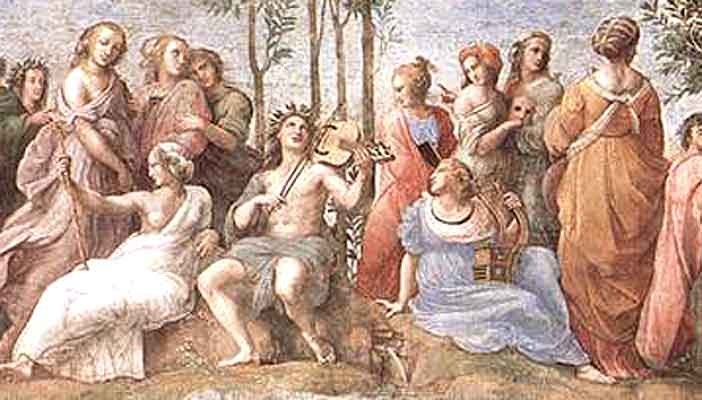
In the standard numbering of Mesomedes' poems, the first two are joined. I think it's quite a beautiful poem.

ἄιεδε Μοῦσα μοι φίλη,
μολπῆς δ' ἐμῆς κατάρχου,
αὒρη δὲ σῶν ἀπ' ἀλσέων,
ἐμάς φρένας δονείτω.

Καλλιόπεια σοφά,
Μουσῶν προκαθαγέτι τερπῶν,
καὶ σοφὲ μυστοδότα,
Λατοῦς γόνε, Δήλιε Παιάν,
εὐμενεῖς πάρεστέ μοι.

Sing to me, beloved muse,
start up my song,
Let the breeze from your sacred grove
stir my mind.

O wise Calliope,
leader of the delightful muses,
and you, wise giver of mysteries,
son of Leto, Apollo from Delos,
kind ones: stand near me.

Note the internal rhyme in lines 2, 3, 4, and 6 as well as the rather uncommon 3rd person imperative in line 4.

Friday, August 21, 2009

Why Thomas Jefferson Was so Smart

Thomas Jefferson's study regime when he was studying law was insane. He divided his day into five periods as follows:

From whenever he awoke to 8:00 AM-- Physical Sciences, Ethics, Religion, Natural Law

8:00 AM to 12:00--Law

12:00-1:00--Economics and Politics

1:00 to dusk--History (American, English, Greek [sources read in the original], Roman [again, sources read in the original])

dusk to midnight--Belles lettres, Oratory, Rhetoric, Criticism. Greek and Latin authors were (of course) read in the original.

It's no wonder he was probably the most learned and cultured President in American history.

Archilochus I

εἰμὶ δ' ἐγὼ θεράπων μὲν Ἐνυαλίοιο ἄνακτος
καὶ Μουσέων ἐρατὸν δῶρον ἐπιστάμενος

A servant am I, of Ares, the Lord
and skilled in the gift that the Muses award.

Thursday, August 20, 2009

Dative/Nominative/Ergative Subjects?!

The case system of Georgian is a giant mess. Basically speaking, Georgian is an ergative language, meaning that it uses the ergative case for 'agents' (subjects of transitive verbs), and the absolutive case for 'intransitive subjects' and 'direct objects'. However, things are not quite this simple. Georgian makes a distinction between unergative and unaccusative subjects.

[Aside of explaination]
Intransitive verbs can be divided into two main classes. Fillmore (1968) posited two general formulas for these:

V + A (intransitive, active subject)

V + O (intransitive, inactive subject)

The first type came to be called unergative verbs (more 'agentive'), while the second were called unaccusatives. Perlmutter and Postal (1984: 98-99) wrote up a list of examples of both types:

Unergative Verbs:

Willed or Volitional Acts- speak, laugh, cry, walk
Manner of Speaking- whisper, mumble, bellow
Animal Sounds- bark, neigh, roar
Involuntary Bodily Processes- cough, sneeze, belch,

Unaccusative Verbs:

Affected Argument- burn, fall, dry
Inchoatives- melt, die, grow
Existing and Happening- exist, happen, arise
Involuntary Emission of Stimuli- shine, clink, stink
[End aside of explaination]

Now, unergative verbs require an ergative subject in Georgian, while unaccusative verbs do not. Moreover, the ergative case also shows up only in past tense constructions (unless it's an unergative verb, in which case it takes the ergative case in the present, past). In the present tense, the subject will appear in the nominative. Languages of this sort have, I believe, been called 'active' as opposed to 'ergative'. Another strange thing: in the perfect tense, the subject is in the dative, of all cases. How this situation arose I have no idea.

Friday, August 14, 2009

I Have Returned...

..., freed from the chains of employment. Working 10-12 hours a day doesn't leave much time for blogging, so my posts have deteriorated in number over the summer (the final count is zero).

However, more are forthcoming on an oddity of the Georgian case system, some thoughts on Greek Lyric poetry, and most likely a rant about the GRE.

Tuesday, April 21, 2009

Why I'm a Masochist, or, My Summer Reading List

Latin:

Cicero Pro Roscio Amerino (already started)
Cicero Phillipic I
Random Catullus Poems
Tibullus; all of his poems

Greek:

Euripides' Bacchae
Homer Iliad Book 24
A book of the New Testament

Other Stuff:

Learn German
Learn Old English or Old Norse

All this while working twelve hours a day six days a week so that I can pay for next year's schooling as well as have some money so I can pay for grad school.

Fun fun. I doubt much of it will get done.

Thursday, April 9, 2009

Audio Recordings of Various Greek Texts

Here are some websites on which there are recordings of various people reading various Greek and Latin texts.


There's a good collection on here, ranging from Cicero and Catullus to Herodotus.

Also, on this site are audio recordings of the entire Greek New Testament.


'Tis pretty cool stuff.

Friday, March 27, 2009

On Greek ἐυπάτωρ

Can we derive Gk ἐυπάτωρ 'having a good father' straight from an IE root? The root would be a so-called nominal composite, that is, a noun formed from two elements, in this case an adverb and a noun. The first element of the compound is unproblematic *h1esu; it is the second part that may cause some troubles. The second nominal element is obviously derived from *ph2-tér-s (nom. sing), which is a standard hysterkinetic noun. The question becomes, then, can we derive an amphikinetic noun from a hysterokinetic one? The second element of the nominal composite would have to be *pá-tōr-s. The accent shift is interesting. From the root *ph2-tér-s, two methods of derivation are possible. First, the root with a syllabic laryngeal would have to hold the accent, so we would have *ph2-tōr-s. There are apparently roots which have accented syllabic resonants, but the roots (the ones for 'wolf' and 'bear') are a bit sketchy to being with, and to my knowledge there are no roots which have an accented syllabic laryngeal. So this, to me, seems unlikely. The second possibility is then the best one: namely that the accent shift occured after the 'loss' of the laryngeal and the creation of the 'a' vowel. Thus, in my view, we would have

*ph2-tér-s > *pa-tér-s > *h1esu-pá-tōr-s >ἐυ-πάτωρ.

and not

*ph2-tér-s > *ph2-tōr-s [with the accent on the root] > *h1esu-pá-tōr-s >ἐυ-πάτωρ.

Given all of this, it seems that whether ἐυπάτωρ comes from a 'true' IE root hinges upon when the shift from *h2 > α happened, which presumably was a post-IE-pre-Greek development. Thus, I would argue that the Greek word cannot be derived straight from an IE root, given that the shift from *h2 > a is a prerequisite of the derivation of the nominal element in the compound. To be fair, though, nominal composites such as this need much more work. Perhaps it's a future project for me.

Tuesday, March 24, 2009

Some IE Poetic Formulas from Watkins

Here are some of the IE poetic formulas which Watkins reconstructs in How To Kill a Dragon. This is by no means an exhaustive list (yet...)

PROTECT (*pah2-) MEN (*ṷihxro-) (and) LIVESTOCK (*peƙu)


GRAIN and BARLEY (*ieṷo-)

COVENATED (*ṷṛh1-to-) RECOMPENSE (*misdho-)

TREE (*dru-) (and) ROCK

PROdat BE (*h1es-) FAME (*ƙleṷos) IMPERISHABLE (*ṇdgʷitom) EVER(LASTING) (*h2ai̯u-)

PROnom HAVE (seĝh-/*dheh1-) FAME (*ƙleṷos) IMPERISHABLE (*ṇdgʷitom) EVER(LASTING) (*h2ai̯u-)

HERO SLAY (*gʷhen-/*ṷedh-) SERPENT/MONSTER (with WEAPON/ with COMPANION)

HERO1 SLAY (*gʷhen-) HERO2

HERO OVERCOME (*terh2-) ADVERSARY

HERO OVERCOME (*terh2-) DEATH

The formulas related to the slaying of the monster/serpent can also be reversed, as in Beowulf, for example, where the monster kills the hero. For a full discussion of these and other formulas see Watkins (1995) How To Kill a Dragon. (New York: Oxford University Press)

Monday, March 23, 2009

Buck's Grammar of Oscan and Umbrian

Here is a link where you can download Carl Buck's Grammar of Oscan and Umbrian in PDF format. 'Tis a decent grammar; it includes some inscriptions and a glossary as well.

Tuesday, March 17, 2009

Gibbon on the Conversion of Constantine

Edward Gibbon hates Constantine. He sees Constantine's reforms as "the mortal wound which had been so rashly or so weakly inflicted...". Interestingly, though, he devotes a huge swath of his History to Constantine, more than any other period in Roman history. This is no doubt because he saw the main causes of the fall of the Roman Empire as barbarism and Christianity. He wrote, burned, and then rewrote this section; he writes,"it is difficult to arrange with order and perspicuity the various transactions of the age of Constantine: and so much was I displeased with the first Essay, that I committed to the flames above fifty sheets." (Memoirs, p. 159). Thus it seems he experienced some frustration when writing the section.

Serious issue is taken with the so-called conversion of Constantine; he regards the two main sources for the event, Eusebius and Lactantius, as next to worthless. The traditional tale runs as follows: prior to the battle of the Mulvian Bridge, Constantine saw a vision in the heavens, which was seen again in a dream of his. In this dream, the emperor was ordered to place the sign on his banner, and fight under the auspices of the Christian God. Constantine proceeded to win the battle.

Gibbon writes, "I shall endeavour to form a just estimate of the standard, the dream, and the celestial sign; by separating the historical, the natural, and the marvellous parts of this extraordinary story, which, in the composition of a specious argument, have been artfully confounded in one splendid and brittle mass." (Decline and Fall XX, 317) He begins first with Lactantius. Of his account Gibbon notes that it was published "at Nicomedia about three years after the Roman victory" which afforded "ample latitude for the inventions of declaimers, the credulity of party, and the tacit approbation of the emperor himself." (Decline and Fall XX, 321). Thus Gibbon seems to think that the account of Lactantius is mere fabrication and that Constantine perhaps had some hand in the creation of the story.

Turning his guns to Eusebius, Gibbon then proceeds to demolish the Church historian's account. He notes that Eusebius only makes mention of Constantine's conversion in his De vita Constantini, and not in his Ecclesiastical History, which was published earlier than the Life of Constantine; in his own words, "the silence of the same Eusebius, in his Ecclesiastical History, is deeply felt by those advocates for the miracle who are not absolutely callous. " (Decline and Fall XX, 323) He then argues that "the advocates for the vision of Constantine are unable to produce a single testimony from the Fathers of the fourth and fifth centuries." Indeed, Gibbon notes that there is no independent testimony from any witnesses of the event in Eusebius, or anywhere else, save Lactantius, and that the sources for both of these accounts was Constantine himself. He takes this to mean that the whole event is a sham, which was fabricated by Constantine.


Why, then, according to Gibbon, would Constantine create such a story? Because he “used the altars of the church as a convenient footstool to the throne of the empire,” (Decline and Fall XX, 314), that is to say, Constantine used the Church to further his position and this story of his conversion served as a propaganda tool. Christians, though a minority, were slowly becoming a powerful force in the Empire, and Constantine, according to Gibbon, recognized this and acted out of a sheer desire for practical advantage; “In the beginning of the fourth century the Christians still bore a very inadequate proportion of the inhabitants of the empire; but among a degenerate people, who viewed the change of matters with the indifference of slaves, the spirit and union of a religious party might assist the popular leader to whose service, from a principle of conscience, they had devoted their lives and fortunes.” (Decline and Fall, XX, 316). Gibbon states later that, “the same motives of temporal advantage which might influence the public conduct and professions of Constantine would insensibly dispose his mind to embrace a religion so propitious to his fame and fortunes.” (Decline and Fall XX, 325)

Thus, Gibbon regards the story of Constantine’s conversion as part of his shrewd operation to gain practical advantage from a conversion to Christianity, and does not hold any real historical weight.

Wednesday, March 11, 2009

Latin 'pasco'

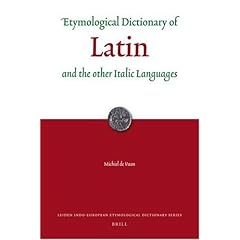
At first glance, the Latin verb pa:sco appears to be one of your usual *ske/o presents. This, however, is not the case; one can tell by the lengthened grade of the root. Normally the *-ske/o- suffix is added to the zero-grade of the root, which would thus yield pasco, with a short 'a' < *ph2-sko instead of *peh2-s- > pa:sco. According to the Etymological Dictionary of Latin by Michiel de Vann, the -sc- in the Latin verb is an "enlarged variant of the 's-present'", this s-present being formed from the root *peh2- 'to protect'. How this 'enlarged variant' comes about, I do not know.

s-presents usually have a desiderative meaning, that is, they express desire or intent. That -sc- is a desiderative suffix on the root *peh2- makes some semantic sense; *peh2-s- would mean 'to want/intend to protect', which leads us to the meaning of pasco in Latin, namely 'to feed, nurture, nourish'

Now I wonder how many other verbs which show this 'enlarged variant' there are.


As a random aside: this series is fantastic. I can't wait for the Greek one which Beekes is preparing to come out.

Monday, March 9, 2009

On the Demise of Classical Music

It is a sorry fact that Classical music has seen its heyday come and go, and I would like to try and outline a few reasons why this occurred

In the 19th century, concert recitals became quite popular due to folks such as Liszt, Thalberg, and other composer-pianists. Normally, composers would merely perform their own works in concert, either at a premiere, or in subsequent performances. Liszt, however, really pioneered the piano recital, in which he would perform not only his own works, but also those of other composers (Beethoven, Chopin, etc). This, as its popularity increased throughout time, gave rise to the structure of modern recitals and performances that we know today.

Now, for a thought experiment. Imagine what would happen if there were around, say, 150 "pop" songs that were regularly performed. That is, artists have stopped creating their own music, and instead do covers of these 150 songs. Now, imagine that these artists were bound by a score, a score which they cannot deviate from, that is to say, they have to sound exactly like the original song. Would pop music not become stagnant and stale? It is for this reason that classical music has lost its mass appeal: artists are (1) not composing anymore (partly because, with the advent of the "recital", they can just perform other people's works), which leads to (2) the same pieces are performed over and over again, and (3) the score of these pieces is sacred, that is to say, it is blasphemous for an artist to tamper with the directions which the composer set forth. In other words, classical music has become stagnant and stale; there is little originality because there can be no originality given the framework which musicians must work under.


What, then, must we do? First, we must to some extent do away with the notion that the score cannot be deviated from. New criteria must be established to judge a "good" performance, for, according to some, a good performance can only be as such if the artist sticks closely with the score. We need more artists like Glenn Gould, who was not afraid to tamper with the score in favour of artistic expression and original interpretation. A good example is his recording of the first movement of Mozart's Sonata in A Major. It is a theme and variations, and, in the score the second to last variation is marked "adagio". Gould, however, plays it like an "allegretto". Lo and behold, it works, it doesn't sound "bad", and even fixes the architecture of the movement: the theme is slow, and, as the movement progresses, the speed and energy picks up, instead of being interrupted by an adagio in the second to last variation. What is needed is strikingly original interpretations such as this: artists must not be afraid to counter the composers intentions. If pop artists did covers which sounded exactly like the original they would not be terribly interesting; similarly, one can only hear so many renditions of Schubert or Chopin which sound robotic because they all follow the letter of the score.

Saturday, March 7, 2009

Laryngeal Reflexes in Latin: Part II

So Matt pointed out that the section in Sihler where he (Sihler, not Matt) goes over syllabic laryngeals may shed some light on why a laryngeal which stands in between two consonants fails to show the triple reflex in Latin. Apparently this is the reason: it's a syllabic laryngeal, which develops differently in Latin as well as Sanskrit, for that matter. (CHC > Lat. CaC, Skt. CiC)

I don't know if I like this explanation. I can't quite put my finger on it, but something seems fishy. I wonder whether Hittite shows any reflexes of these syllabic laryngeals. Off to Kloekhorst!

Wednesday, March 4, 2009

Laryngeal Reflexes in Latin

So, apparently one can argue that there is a triple reflex of the laryngeals in Latin; I was looking through The Blackwell History of the Latin Language (2007)by James Clackson and Geoffrey Horrocks, and stumbled upon this. I was under the impression that it was only Greek that showed this triple reflex. I shall have to look into this further.

Here are some reflexes which Clackson & Horrocks use to support this conclusion:

*eh1 > Lat. e:, Gk. e:, Skt. a: Ex. *dheh1- > Lat. fe:-ci, Gk. ti-the:-mi

*eh2 > Lat. a:, Gk. a:, Skt. a: Ex. *peh2- 'pasture' > Lat. pa:-sco, Hitt. pahs-

*eh3 > Lat. o:, Gk. o:, Skt. a: Ex. *deh3 'give' > Lat. do:s, Gk. di-do:-mi, Skt. da-da:-mi

However, it seems that this only occurs under certain conditions. For example, when a laryngeal stands on its own between two consonants, it seems to always develop into Lat. 'a'; Greek, naturally, still shows the triple reflex. So, when a laryngeal is next to an 'e' in PIE, the reflexes seem to be the same as in Greek, namely 'e', 'a', and 'o'. Cf:

*h1esti > Lat. est

*h2ent- 'front' > Lat. ante

*h3ekw- 'eye' > Lat. oculus

but:

*sth2to- 'standing, stood' > Lat. status

*dh3to- 'given' > Lat. datus

Quite curious. I wonder why.

Tuesday, March 3, 2009

Aeneid Book 4

Let us delve in and see what we can come up with.

At regina gravi iamdudum saucia cura
vulnus alit venis, et caeco carpitur igni.
multa viri virtus animo, multusque recursat
gentis honos; haerent infixi pectore vultus
verbaque, nec placidam membris dat cura quietem. (1-5)

postera Phoeba lustrabat lampade terras,
umentemque Aurora polo dimoverat umbram,
cum sic unanimam adloquiter male sana sororem: (6-8)

Note first all of the hard palatal sounds in the first five lines; this adds effect to the jarring, harsh state which Dido is in. Here Virgil is describing how the queen is completely consumed with love for Aeneas, and the palatals lend an air of harshness to the lines. Note also that there are many voiceless dental stops; the t's are also a harsh sound.

Note then how things change in the next three lines. In the description of the dawn breaking (6-7), we find mostly soft sounds: labials and liquids predominate, and we don't find nearly as many of the harsher sounds like in the first five lines. The lines sound softer and more gentle; the two sets of lines juxtaposed to one another create an interesting contrast between the soft dawn and the harsh passion which Dido is captured by.

More thoughts will be posted as they occur to me.